
Azal University for Human Development Strengthens its International Research Presence and Launches an Integrated Digital Ecosystem for Open Knowledge, Indexing, and Scholarly Verification
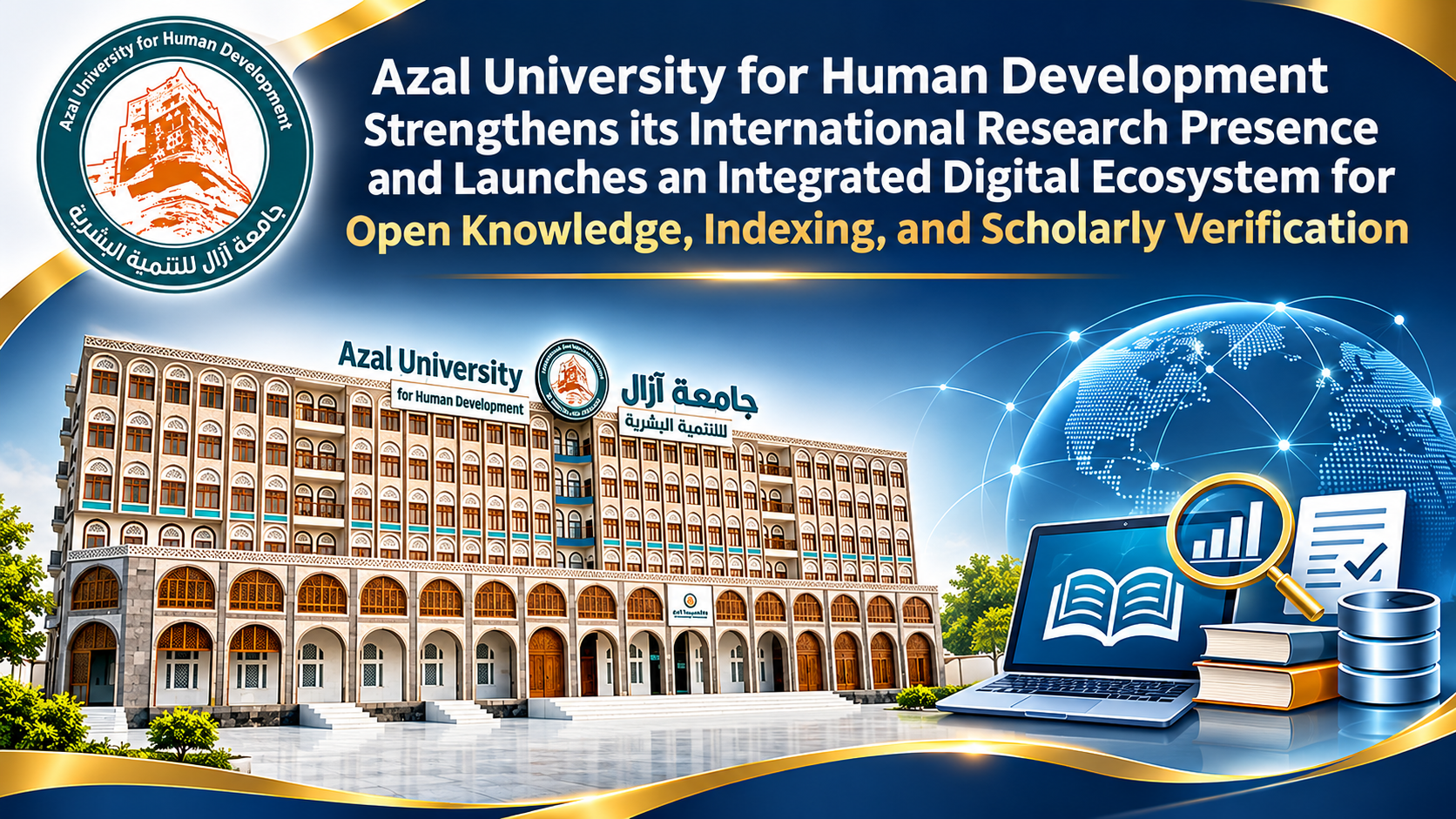
Azal University for Human Development Strengthens its International Research Presence and Launches an Integrated Digital Ecosystem for Open Knowledge, Indexing, and Scholarly Verification
Azal University for Human Development Strengthens its International Research Presence and Launches an Integrated Digital Ecosystem for Open Knowledge, Indexing, and Scholarly Verification
In a new step reflecting its strategic direction toward digital transformation, advancing scientific research, and strengthening its academic presence at the international level, Azal University for Human Development (AUHD) continues to expand its digital and research infrastructure by establishing and developing an integrated ecosystem of knowledge portals, interactive research indexes, and scholarly verification tools, while strengthening the linkage of its institutional identity with international academic platforms and databases.
This development builds upon a series of achievements recently announced by the university, foremost among them its listing in the Global University Directory of the World Assessment Council (WAC), the inclusion of the Faculty of Administrative and Human Sciences in the EDIRC directory of the international RePEc network, as well as the establishment of an institutional research repository on Harvard Dataverse and the publication of the first edition of its research index comprising 725 bibliographic records.
These efforts align with the university presidency's vision to enhance international institutional and research visibility, develop knowledge management tools, improve research data quality, and expand access to the university's scientific output.
Azal Open Knowledge Portal
As part of developing its digital research infrastructure, the university established and developed the Azal Open Knowledge Portal as a digital platform aimed at organizing and making research and academic resources accessible, facilitating access for researchers, faculty members, students, and interested stakeholders to scientific data and their original sources.
The portal provides dedicated pathways to explore the research index, access repositories and academic sources, and view bibliographic metadata and scholarly links, alongside multilingual interfaces to broaden its reach. An additional mirror version of the portal has also been deployed via Cloudflare Pages to provide an alternative access channel to knowledge resources and the research index. The portal represents one of the digital initiatives through which the university seeks to promote open science practices and advance research knowledge management.
Azal Open Knowledge Portal: https://azal-open-knowledge.lovable.app/
Cloudflare Pages Mirror: https://auhd-open-knowledge.pages.dev/
An Interactive Research Index Comprising 725 Bibliographic Records
Development efforts included launching an interactive research index that enables browsing the first edition of the university's institutional index, comprising 725 bibliographic records of research and academic works, of which 654 records include permanent Digital Object Identifier (DOI) links to original sources.
The index allows searching by titles, author names, keywords, and available metadata, with filtering options by scientific fields and publication years, facilitating access, organization, and utilization of records in academic studies and reports.
This project extends the university's institutional research repository on Harvard Dataverse, where the first edition of the index was published with a permanent DOI, enhancing data accessibility and scholarly citation. The index serves as an updatable and expandable bibliographic database; its record count does not imply full-text deposit of all works or completed verification of all institutional affiliation records.
Research Index – Issue 01: https://azal-open-knowledge.lovable.app/issue-01.html
Interactive Research Index: https://auhd-research-index-725.lovable.app/research-index-725/index.html
Index on Cloudflare Pages: https://auhd-open-knowledge.pages.dev/research-index-725/
Developing the Scholarly Verification Portal and Faculty & Research Directory
In a parallel track, the university developed a specialized digital portal for scholarly verification (Azal Scholarly Verification), featuring a directory of faculty members and scientific output, and providing supporting tools to organize academic data and review publication records and institutional affiliations.
The portal presents a directory comprising 302 faculty member records within the listed data, categorized by colleges, departments, and specializations, along with verified publication data and scholarly links based on available evidence. This initiative aims to advance scholarly documentation mechanisms, improve research data quality, and support ongoing review and updating to strengthen the accuracy of information used in institutional reports, rankings, and international indexing files. Directory data are subject to continuous updating and verification, and listing any name does not constitute an independent confirmation of current employment status.
Scholarly Verification Portal: https://azal-scholarly-verification.lovable.app/
Strengthening Institutional Research Identity in International Databases
On the international research identity front, Azal University for Human Development holds an institutional identifier in the Research Organization Registry (ROR), contributing to standardized institutional identification and facilitating the linkage of its research data with international academic platforms. The university also maintains institutional profiles and records across prominent global platforms and databases, including OpenAlex, OpenAIRE, Wikidata, and ResearchGate, in addition to institutional affiliation appearances in selected scientific publications available on PubMed Central.
In an additional technical milestone, the institutional research index record published on Harvard Dataverse has appeared within the OpenAIRE Graph via DataCite, enhancing the discoverability of the research record within the open scholarly data ecosystem. The university continues to refine metadata and strengthen linkage between research records and its ROR identifier to support accurate institutional attribution and expand international research visibility. This progress is part of an ongoing technical trajectory and does not imply complete institutional linkage of all records or indexing of all research across the mentioned platforms.
International Institutional Identifier (ROR): https://ror.org/02zv8ns48
Research Profile on OpenAlex: https://openalex.org/I4405255415
University Page on OpenAIRE: https://explore.openaire.eu/search/organization?pid=https:%2F%2Fror.org%2F02zv8ns48
Digital Identity on Wikidata: https://www.wikidata.org/wiki/Q142018361
University Page on ResearchGate: https://www.researchgate.net/institution/Azal-University-for-Human-Development
Example of Institutional Affiliation on PubMed Central: https://pmc.ncbi.nlm.nih.gov/articles/PMC12528741/
Expanding Presence in Open Scientific Repositories
As part of the university's efforts to expand knowledge access channels, a community under the name of Azal University for Human Development is available on Zenodo, linked to its international institutional identity, providing an additional channel to represent the institution within the open scientific repositories environment. This channel integrates with the institutional research repository on Harvard Dataverse and the research resources available on the university's website and digital portals, supporting organized knowledge sources and enhanced discoverability and access.
University Community on Zenodo: https://zenodo.org/communities/auhd-research/records
Institutional Repository on Harvard Dataverse: https://dataverse.harvard.edu/dataverse/auhd-research
Published Research Index (DOI): https://doi.org/10.7910/DVN/WU0FVP
Research Page on University Website: https://www.auhd.edu.ye/researches
Developing a Digital System for International Rankings and Indexing Management
In parallel with developing the research infrastructure, efforts included creating and advancing digital tools to organize and track international university rankings and research indexing files, documenting correspondence, submissions, evidence, indicators, and related documents. These tools aim to enhance institutional follow-up efficiency, organize information and data, identify international requirements, and strengthen university readiness when engaging with ranking agencies and research databases, including Times Higher Education, QS, Scopus, and other specialized bodies. These activities form part of an ongoing institutional development process, with continued follow-up on applications and procedures whose final outcomes are still pending.
Sustainability and Community Impact Within Institutional Development
The university's efforts also extended to preparing and documenting 2025 sustainability and community impact reports, reflecting its commitment to institutional transparency and measuring its contributions to community service and development. Documentation covered reports linked to the United Nations Sustainable Development Goals, foremost among them Good Health and Well-being, Quality Education, Gender Equality, and Partnerships for the Goals, alongside other sustainability areas.
The work also included preparing the 2025 Community Impact Report, which highlights the university's contributions in health, education, opportunities, and community partnerships. These reports strengthen the institutional evidence base, improve documentation and impact measurement processes, and enhance university readiness to participate in international rankings focused on sustainability and social responsibility.
An Institutional Vision Toward a Broader Academic and Research Presence
These achievements extend the directives and vision of the Presidency of Azal University for Human Development toward advancing institutional performance, accelerating digital transformation, supporting scientific research, and expanding the university's academic and research presence regionally and internationally. They reflect integrated efforts across knowledge management, research indexing, institutional identity development, scholarly documentation, and sustainability, contributing to a scalable and continuously evolving digital ecosystem.
The university reaffirms its commitment to continuing to develop these initiatives, improving the quality of its research data, and encouraging faculty members and researchers to contribute to completing the documentation of scientific output and updating publication and institutional affiliation records in service of its academic and research mission and openness to the international scientific community.
Azal University for Human Development... Empowering People, Enriching Knowledge, Shaping the Future.